
Hawaii Mugshot Access
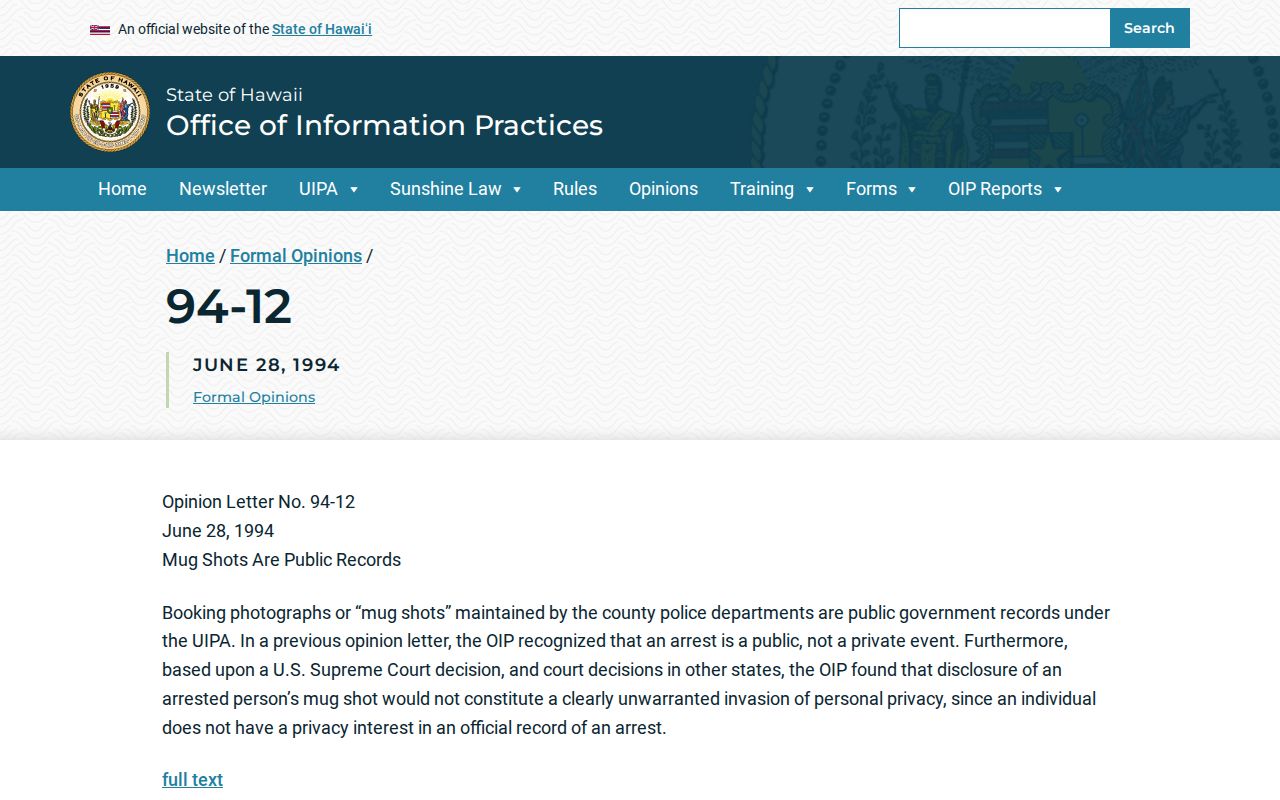
Hawaiʻi gives no blanket answer. The Hawaiʻi Uniform Information Practices Act, Chapter 92F instead controls access to state and county agency records. People call it UIPA. In Opinion 94-12, the Office of Information Practices treated county booking photographs as government records. Release, it held, would not be a clearly unwarranted invasion of personal privacy on those facts. That request came from Hawaiʻi County. The reasoning reaches statewide. Still, no department was ordered to publish photos on a web page or push them into a live feed.
A written request to the holding agency often works best when a county log lacks an image. Staff weigh the record's facts against any UIPA exception. Outcomes differ. A response might include a copy, a redacted record, a denial citing a legal basis, or a request for clarification. The agency decides first. Each request stands on its own facts.
The state guidance sits in OIP Opinion 94-12. That legal opinion answers one specific request rather than ordering any public photo gallery.
Who decides on a specific photo? The arresting department or other custodian makes the initial call under current law and the record's own facts.
Hawaii Mugshot Law Timeline
Hawaiʻi has no general statute aimed at commercial mugshot sites. Charging a fee to remove a booking photo breaks no current statewide ban. Lawmakers tried in 2024. Senate Bill 2631 was titled "Relating to Arrest Photographs." It would have added a commercial mugshot provision to Chapter 481B. The ban covered soliciting paid removal. Civil remedies were proposed too, along with exceptions for news reporting and certain legal work. None of that describes law now in force. A bill is only a bill.
SB 2631 cleared the Senate and moved to the House. There it was referred and deferred, and it never reached the final 2024 Acts list. The current text of HRS Chapter 481B contains no mugshot section. Any new legal right would require a new enactment. A proposal creates none. Neither does a committee report or an old news story.
| Point in the record | What it means now |
|---|---|
| 2024 proposal | SB 2631 described a commercial-publication and removal-fee rule, but it remained a proposal. |
| Final 2024 acts | The enacted-acts compilation does not list SB 2631 as a law. |
| Current Chapter 481B | The current chapter does not contain the proposed mugshot section. |
Want the proposal's full wording? The official SB 2631 text shows what legislators weighed, though its draft language is neither a present ban nor a promised remedy.
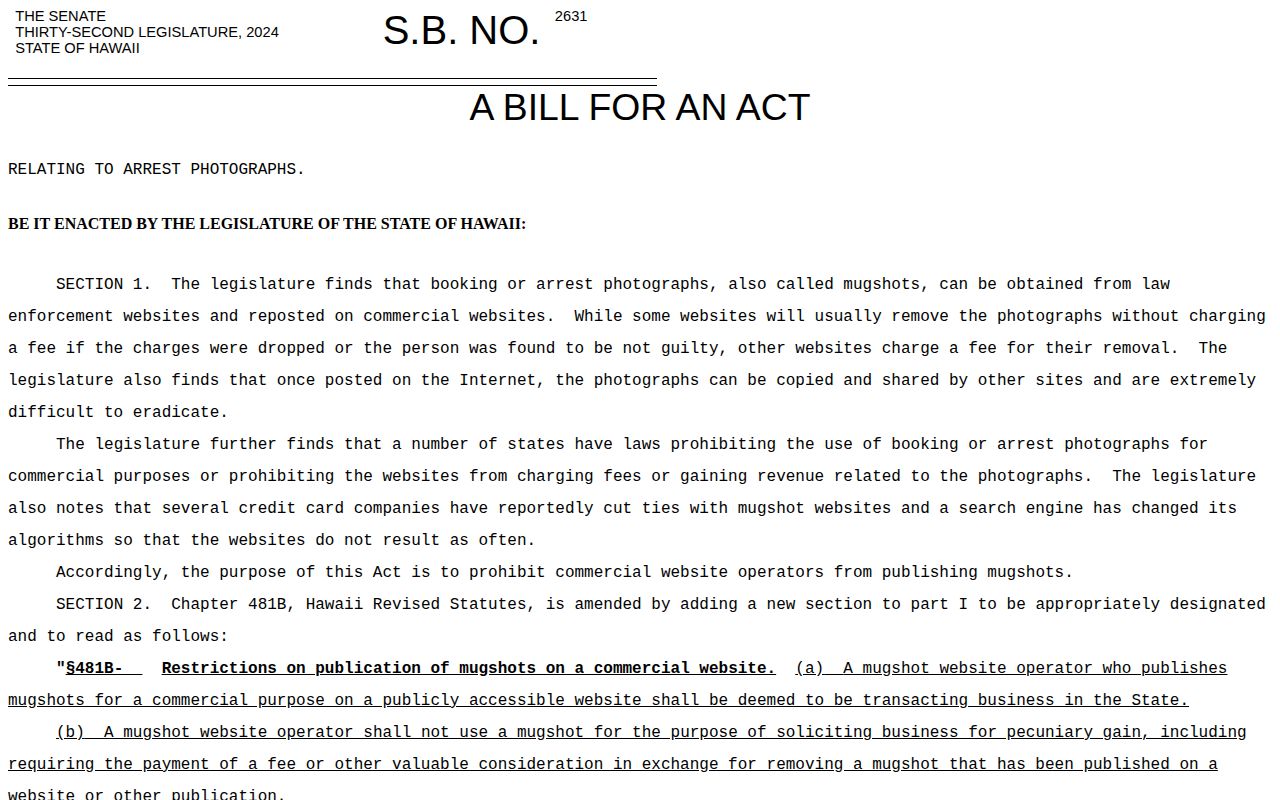
Did the bill become law? Trace it through the final 2024 Acts compilation beside the current chapter. SB 2631 is not there. So no special anti-commercial statute exists. That gap is not a blessing on every publication or use. UIPA, criminal-history limits, juvenile confidentiality, expungement orders, and agency policy can still restrict disclosure or use. Public status never makes a misleading caption accurate.
How OIP Treats Hawaii Mugshots
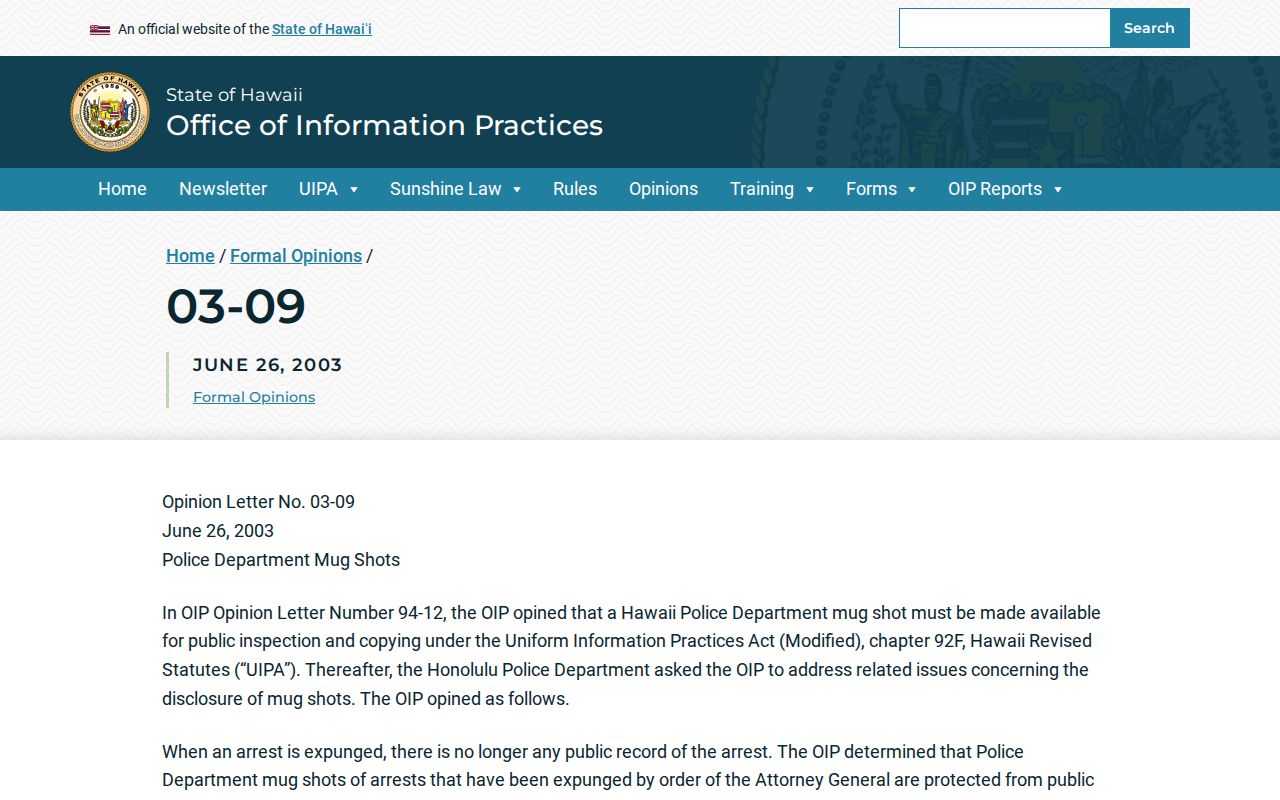
Expungement changes everything. Under Opinion 03-09, an expunged arrest is no longer a public arrest record for ordinary inspection. The police mugshot becomes protected too. UIPA shields records whose disclosure is prohibited by law. A possible future expungement, though, is not enough on its own to withhold a photo that is currently disclosable. The agency must judge the actual record under the law in force when the request arrives.
The opinion also draws lines between record types. Current or pending arrest information sits apart from arrest data less than a year old, and both differ from nonconviction data kept as criminal-history record information. HRS Chapter 846 governs that data. The chapter covers collection and dissemination, including the limits in §846-9. Those rules matter for history requests, not single incidents. A booking log, a case file, and a criminal-history response are not the same product.
Need the source? The OIP Opinion 03-09 page covers expungement, juvenile records, and nonconviction information. Read it alongside HRS Chapter 846. A recent arrest listing, standing alone, is never a complete criminal history.
OIP opinions guide agencies and the public alike. They are not court orders. If an agency denies a request, ask it to name the legal basis and check OIP's current guidance on review options.
Hawaii Mugshot Access Limits
UIPA starts with a duty to disclose. That duty bends, though. Privacy interests, an open investigation, confidentiality imposed by another law or a court order, and similar protected concerns can lead an agency to withhold material or redact it. A police department may pause to weigh whether a release would affect a live case. Even after an opinion rejects a broad, automatic privacy claim, the fact-specific limits stand.
Juvenile information has a firmer boundary. HRS Chapter 846 sets a separate rule for juvenile records, and OIP opinion 03-09 permits disclosure only as that statute authorizes. Honolulu's adult arrest log keeps juvenile arrest information out. So do not seek a juvenile's booking photo. A public adult case later on does not make an earlier juvenile image public by default.
Know what kind of record you want. A log may show the arrest event and a few public fields, yet hold no photo, investigative file, victim details, or later court result. A court index can show a case while blocking sealed documents. A criminal-history response answers to its own dissemination rules. Ask for the record by type and date. Then follow the custodian's answer on any redaction or denial.
Note: A missing online photograph can reflect agency policy, a limited feed, or a legal restriction, and does not establish that no booking image exists.
Request Hawaii Booking Photos
Send a UIPA request to the agency most likely to hold the record, not to the Office of Information Practices first. Name a specific record. Say how you want the answer delivered. A separate request may be needed for each agency involved. If the arresting department and the jail differ, ask the arresting agency for its booking record and photo, since a custody record may sit with another custodian. No statewide search form pulls every county's image.
The most useful request stays narrow. The easier it is to route, the faster it comes back. Give the person's full name, the county, an approximate arrest or booking date, and a report or booking number if you have one. Request the record and the photo as separate items. If some details are protected, ask whether the agency can release a redacted copy. You generally do not need to state a reason.
- Identify the police department or other agency that made the arrest and holds the record.
- Send a written request describing the date, person, county, and exact record, with a preferred delivery method.
- Ask the agency to cite the legal basis for any denial and to release nonexempt parts when possible.
- Track the response. OIP says agencies generally respond within ten business days, or tell the requester that more time is needed, usually up to ten additional business days for extenuating circumstances.
That deadline is a target, not a promise. An agency may ask for clarification or prepayment. It may redact material or explain why a record is withheld. OIP's request instructions lay out the written process and the route for getting help. Keep the request on the public record itself. Do not demand that a department publish the image online.
Expungement and Court Sealing
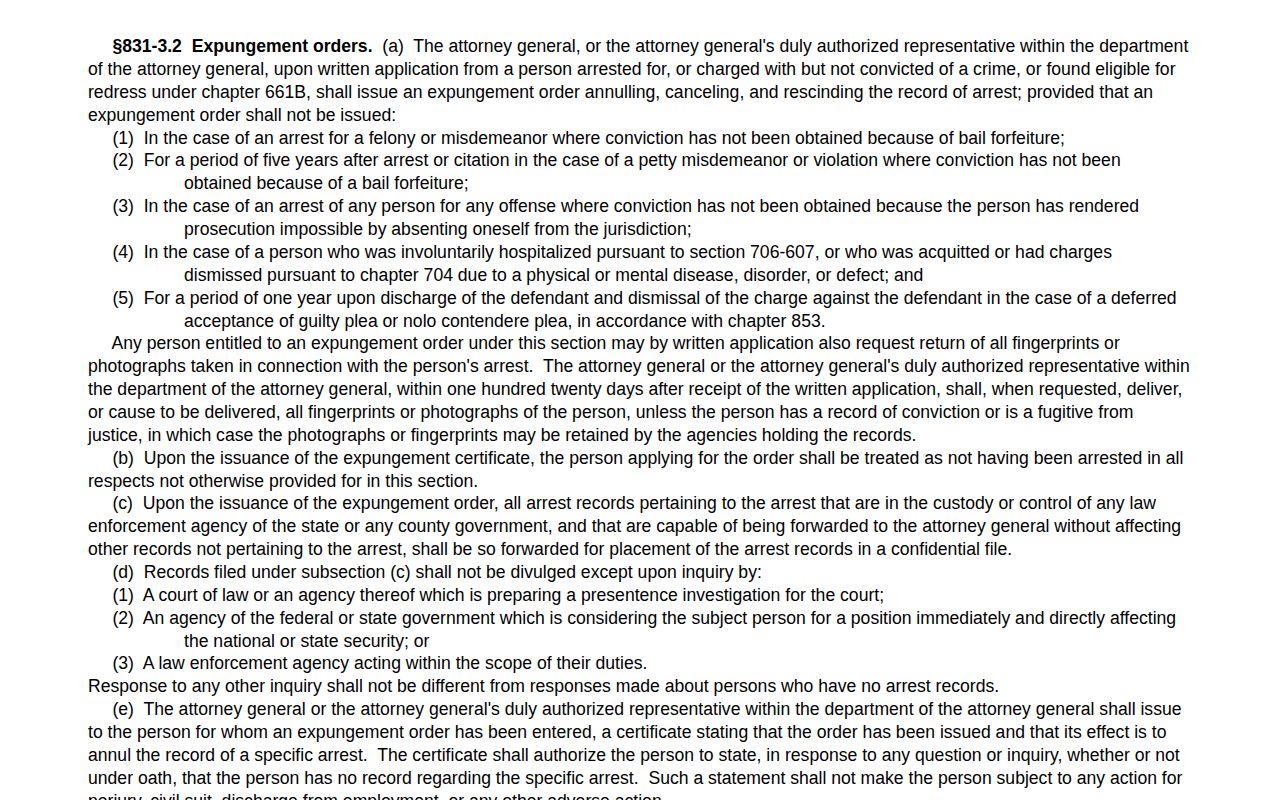
Expungement offers a formal path for qualifying arrest records. It covers people arrested or charged but never convicted. Under HRS §831-3.2, a written application goes to the Attorney General or an authorized representative. Eligibility turns on the case and its disposition. The statute lists firm exclusions. They include arrests with no conviction because bail was forfeited, cases where leaving the jurisdiction made prosecution impossible, certain Chapter 704 findings, and deferred-acceptance matters during a stated waiting period after discharge and dismissal.
So a dropped charge is an incomplete answer. The specific charge matters, along with the court's final action, the reason no conviction entered, and any statutory exclusion. Bail-forfeiture petty-misdemeanor and violation matters carry a five-year period. Deferred-acceptance guilty or no-contest matters carry one year after discharge and dismissal. Other exclusions skip the clocks entirely. The Hawaiʻi Criminal Justice Data Center publishes expungement instructions and an FAQ; check them for the current process instead of assuming eligibility.
The statute defines an arrest record broadly. It includes photographs and fingerprint cards. An applicant may ask for those materials to be returned rather than kept on file. On request, the Attorney General's office must deliver them within 120 days after receiving the written application, subject to exceptions for a person with a conviction or a fugitive from justice. Qualifying law-enforcement records then go into a confidential file. Ordinary public inquiries receive the same response as if the person had no arrest record.
The statute page for §831-3.2 is the controlling text. It spells out the application, the exclusions, and the rule on returning photos. Details beyond a short summary live there. Anyone weighing an application should read the statute itself when the specifics matter.
Check the disposition and the agency record before filing. Expungement is not automatic erasure after an acquittal, a dismissal, or the passage of time.
| Process | What it changes | What it does not promise |
|---|---|---|
| Expungement | Qualifying arrest records held by law enforcement move to a confidential file, with statutory limits on disclosure. | It does not guarantee eligibility or erase every old copy made by an independent publisher. |
| Court sealing or removal | Qualifying public electronic court material may be sealed or removed under Judiciary procedures. | It does not automatically correct a separate police record or third-party copy. |
Note: Confirm the order's scope with the agency and court that hold each record, since different systems may need separate correction steps.
Hawaii Expungement After July 2025
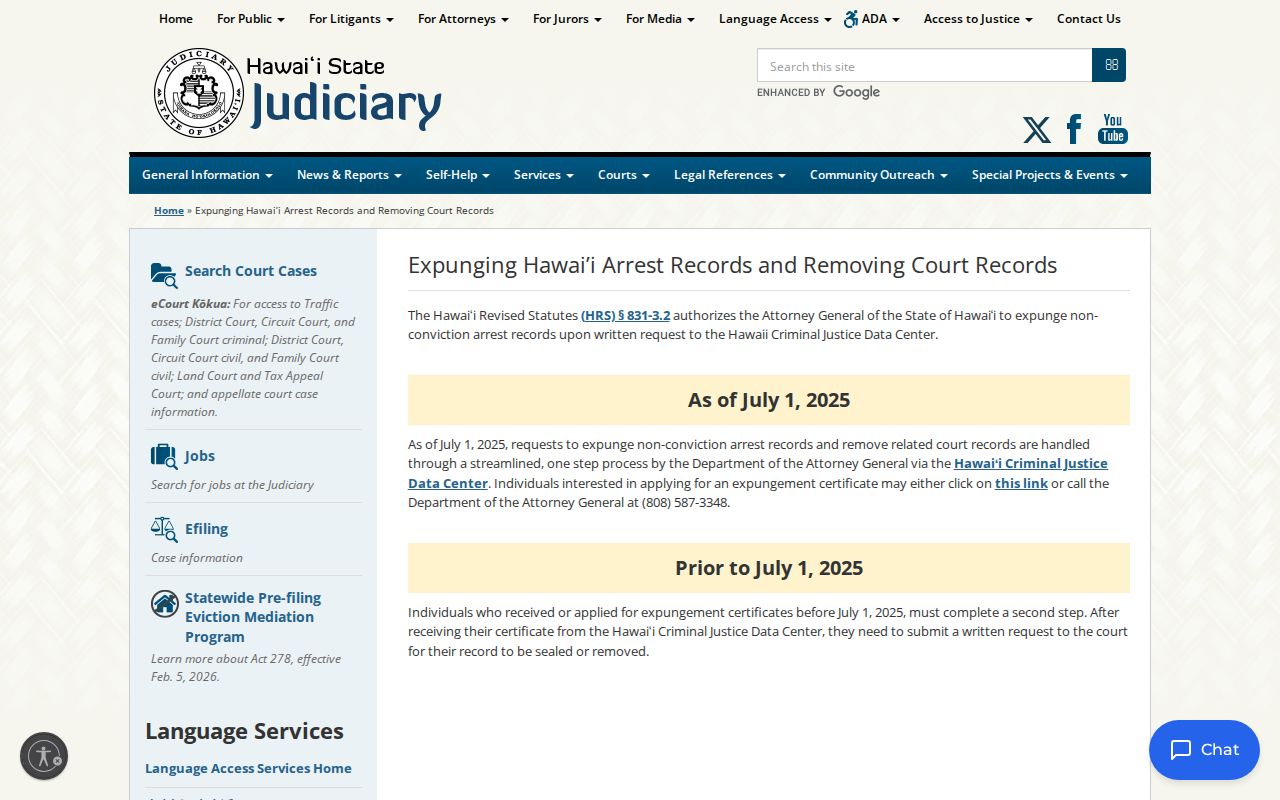
A new pathway began July 1, 2025. The Judiciary now describes a smoother handoff for qualifying expungement orders. Here is how it works. The Attorney General forwards the order, along with the court case number, to the Judiciary. From there, the Judiciary makes good-faith efforts within a reasonable time to seal or remove the matching public electronic court material. This step concerns court records only. It follows from an expungement order, so it is not a way to bury a case that the law keeps public.
Exceptions exist. A case can carry other charges that were never expunged. It can also involve several defendants when only some of them qualify for the order. Anyone who received or sought a certificate before the change was told to finish the old second step by petitioning the court on their own. For current forms and instructions, the Judiciary sealing and removal page is the place to look, and it spells out that processing stays within the order's scope and statutory limits.
Hold onto the expungement order and the court case number whenever you ask for a correction. Those two items anchor the request. If a public page survives even after the agency and court have processed everything, ask the custodian whether the source record itself changed before you approach a search engine.
Free Corrections for Hawaii Mugshot Listings
A few unofficial publishers run their own correction channels at no cost. Treat these as house rules. RecentlyBooked spells out what it will consider. That covers dismissed cases, expunged or sealed matters, wrong or outdated details, mistaken identity, juvenile listings, and duplicates. To act, it wants the page link. It also asks who you are, the arrest facts, a reason, and any legal paperwork that backs the claim. The site notes one limit. If the underlying record stays public with the agency that holds it, the listing usually stays put.
Mugshots.com takes a similar approach through a record-maintenance process. Hand over a record identifier plus documentation. The site may update the listing when a favorable disposition applies, and removal depends on its own stated criteria. Busted Newspaper offers a free form too. It collects the listing URL, your contact information, a reason, and legal papers for sealed or favorable outcomes. Processing can take several days, the site warns. Remember the limits here. No publisher controls a police department, a court, or a search engine. These channels change nothing at the source.
Be careful before you send anything. Confirm the operator's current policy yourself and share only what its process actually requires. Keep a copy of whatever you submit. Skip anyone demanding payment for guaranteed deletion, since money cannot rewrite a court outcome or force a government custodian's hand. And a free takedown proves nothing about whether the original record was ever wrong.
The published policies sit with RecentlyBooked, Mugshots.com, and Busted Newspaper. Read them as each publisher's own procedure. They are not Hawaiʻi law.
Clear Stale Search Results Last
Search listings can outlive the government pages beneath them. So work in order. Start with the source agency, or the Judiciary when a court record is involved. Confirm each eligible record was truly corrected, sealed, or removed. Only then turn to a search engine's outdated-content process. Use it for a result still pointing at a page that changed or vanished. Google's outdated-content tool offers one route for stale results.
Remember what this step can and cannot do. It refreshes a listing. It does not judge an arrest's legality. It cannot force a publisher to drop a valid copy or rewrite the record itself. Suppose the source page still shows the old information. A cache request alone may fix nothing. Go back to the agency or court and ask which record remains public.
County custodians hold recent Hawaiʻi arrest logs. The statewide booking-record lookup points you to an official county path for those. Someone serving a state sentence falls under a different system than a county booking file. The DCR records page explains that split.